SOCIAL MEDIA

Showing posts with label Vocabulary. Show all posts
English Language Learners need a lot of opportunities to practice their vocabulary in all four language domains. Students need to work on Listening, Speaking, Reading, and Writing. As an ESL teacher, I was always looking for new and exciting ways to practice those language skills. Reading skills can be hard for English Language Learners to acquire. There are many components - decoding, fluency, comprehension. These activities practice a mix of all three and can be used with any vocabulary list. These activities are simple to prepare, and require no fancy materials.

Scrambled Sentences

This activity is a simple one with many variations. The idea is that students will need to reassemble a sentence or passage after it has been all mixed up. Start by writing or typing out sentences that use your target vocabulary. Then cut each word apart and mix it up. For students who need more support, you can provide a sample sentence that they then match the mixed up pieces too. If you want to add movement to the activity, give students an envelope with the mixed up sentence in it, and tape a matching sample sentence to the board. Students go up to the board, read the sentence then return to their desk to put the sentence together. If you want to make that more challenging, add a few extra words to the envelope. If your students enjoy some healthy competition, split them into two groups and make it a race! You can also do this with a short passage, cutting apart sentences instead. I used an activity like this to practice opinion writing. You can read about that and grab a free activity here.

Fill-in-the-blanks

This is another activity that is very simple to set up. Simply write out sentences using your target vocabulary, and then delete the target word and place a blank. Students will need to read the sentence and decide which word best fits. You can provide a word bank if that helps your students. You can make it more challenging by changing the word grammatically. For example, write the sentence so that students need to add an ‘s’ or ‘ing’ to the word. 

Odd One Out

“One of these things is not like the other…” Admit it, you sang that. Well that is the idea behind this game. Provide students with three or four words or sentences and ask which one doesn’t belong. For example you could say, “sloth, toucan, cow, anteater”. Students would identify the cow as the odd one out, since it is a farm animal, not a rainforest animal. You could also do singular vs plural words, common vs proper nouns… the ideas are endless. If you want to bump it up a notch, do the same with sentences. Maybe writing two facts and an opinion, or two sentences in the present tense and one in past tense.

Ball Toss

You’ve probably seen or played this game yourself. It is a fun one, especially for kids who like to get up and move. Simply write some words or sentences on a ball and toss it around. Whoever catches the ball reads the word or phrase facing them. You can do this with a beach ball - simply write the words on the ball before inflating it. If you use a sharpie on a beach ball, you may even be able to erase it afterwards with a magic eraser or hand sanitizer. This may work differently on different beach balls though, so test it first! Another option is to write the words or phrases on address labels and then stick them to a playground ball. This way you can simply remove the labels, and use the ball for a different game later on. 

Kaboom!

This fun reading game is great for vocabulary or high frequency words. Write out your target words on large popsicle sticks. On a few popsicle sticks write the word Kaboom! Place all of the sticks into a cup. Students pull a stick from the cup one at a time and read the word. If they pull a stick which says Kaboom! they put back all of their sticks. You can keep going around the group until time runs out, or all of the sticks have been claimed. If you don’t have popsicle sticks, you can write the words on folded paper and put them in a bucket to pull from.

Wacky Punctuation

This activity is great for practicing reading fluency, and is best for older students who are working on understanding punctuation. Write out sentences or a passage and change the punctuation at the end of a sentence, or add in an extra comma. Students will read the sentence out loud using the tone, volume, and pauses associated with the punctuation you’ve inserted. 

Follow the Directions

This activity is one I talked about in my Listening Activities blog post, but it can also be used as a reading activity by simply giving the students the directions written out, rather than reading them out loud. First, find a coloring page that uses some of your target vocabulary. Then write out directions for how you want your students to color the page. Give your students those directions on paper so that they can read and color. 

Reading Tower

There are two pays to play Reading Tower. In the first version you write words or sentences with your target vocabulary onto blocks. Then students take turns choosing a block and reading it out loud. If they read it correctly, they can place the block on their tower. If they do not read it correctly they need to return the block. Play continues until all of the blocks are gone. You can use any type of block for this, wooden blocks or toddler building blocks work well. In the second variation, you can play Jenga. This is great for a review game when you have a lot of vocabulary to write on the blocks. Put one word on each block. When a student pulls out that block, they must read the word before placing it on the top of the tower. You can add some complexity to this by asking them to read the word and then use it in a sentence or define it. 

Word Hunt

Word hunt is exactly what it sounds like, and one of the activities I mentioned in my Vocabulary Activities Blog Post. For this activity you give students a book or passage with the target vocabulary and ask them to find the words. You can give them sticky notes to flag the words, or highlighter tape. Picture books are great for this activity.

Read

Ok, so maybe this one is obvious, but in order to sharpen their reading skills, students need to be given time to read. No fancy game, no activity, or questions, just simple, for-pleasure reading. With all that we want to accomplish in the little bit of time we have with our students it can feel like there is no time. I usually used free reading as an early finisher task. You can make free reading part of your class routine, maybe the first five minutes of the group time is dedicated to reading quietly. It can also be a reward they are working toward - a teddy bears and books day. No matter how you do it, giving students time to simply read will help them become better readers.


Are there any reading activities your students love that I missed? Did you try one of these activities? Share them with me by commenting or connecting with me by email, michelle@teachingeternity.com, or find me on instagram, @TeachingEternity.


10 Fun Activities To Help Improve Reading Skills You Can Try Today

Thursday, April 14, 2022

English Language Learners need a lot of opportunities to practice their vocabulary in all four language domains. Students need to work on Listening, Speaking, Reading, and Writing. As an ESL teacher, I was always looking for new and exciting ways to practice those language skills. These are 10 activities you can use to practice speaking skills. These activities can be used with any vocabulary list, and do not require a lot of preparation or fancy materials.


Debate


A debate is a great way to practice speaking skills. As opposed to a presentation of a set of facts, a debate encourages students to speak convincingly. You may need to do some modeling of how to use tone and volume to help students with this skill. To set up a debate in your classroom split the group into two teams. Provide a statement that is open for debate such as “Zoos are a good place for animals,” or “Schools should be open all year”. Assign each team a position - either they argue for or against the statement. Then give each team time to discuss their position and come up with talking points. After a set amount of time, have students from each group share their talking points. When you are done with the debate you can poll students on which side of the statement they fall, and which argument they felt was most convincing.


Interviews and Surveys


Asking and answering questions is an important speaking skill for English Language Learners. Conducting interviews and answering surveys is a great way to practice these skills. You can have students do a simple getting to know you survey at the beginning of the year where they ask and answer questions of each other. Or you can do interest surveys with students one-on-one. These activities will not only help practice speaking but they will help build relationships in the classroom. You can also have students write questions and then survey community members. With modern video call technology students might actually be able to interview a zookeeper during your zoo unit, or a local meteorologist during a weather unit. 


Poetry


Poetry reading is a great way for English Language Learners to practice speaking. So great in fact, that I have an entire blog post about it - HERE. To practice speaking with poems, search online for a poem that matches your current theme. If you can’t find one you can write one yourself. I find it best to choose a recognizable rhythm from a nursery rhyme and then write lines to match that rhythm. Then present the poem to your class. Our routine was for the students to first listen to me read the poem all the way through, then we would do a call and repeat of each line, then gradually increase the text read until they were able to recite the entire poem. I would do this as a whole-group activity. 


See, Think, Wonder


See, Think, Wonder is a great way to get students to notice and talk about details. For this activity, you will need to find a photograph that will interest your students and give them a chance to practice target vocabulary. I recommend checking out a free photo website like Deposit Photos or Unsplash to find quality photos. Once you have a photo ask your students what they see in the photo. Ask them to talk about the big picture as well as small details. “I see a lion roaring” and “I see dirt in the lion’s mane”. Then move on to what students think about the picture. This requires more higher-level thinking, and probably more language production. “I think the lion is angry because he is roaring.” The final step, and the most difficult question, is to ask students what they wonder about the photo - “I wonder how loud the lion’s roar is?”


Show and Tell


Raise your hand if show and tell was always your favorite day in school. *raises hand* Students love show and tell! This is pretty straightforward - students bring an item to class and tell their classmates all about it. If you have a student who isn’t able to bring in an item they’d like to discuss, you can ask them to draw a picture of it, or ask their parents to send in a photo. If you want to keep the show and tell thematic you can present the students with realia related to your theme and ask each student to present one item to the group. 


Skits


What kid doesn’t love playing pretend. Come up with a few different scenarios relating to your current unit. Make note of how many ‘actors’ each scenario will need - try to stick to 2 or 3. Break your group up and give each pair or triplet a scenario. Give them time to practice what they would do and say if they were in that situation. As groups practice, you can walk around the room to offer suggestions and observe their speaking skills. If it is appropriate for your students, each group can present their skit to the class. You can really bump this activity up a notch by providing props!


Taboo


The popular game Taboo is all about speaking! To set up play, choose target words and taboo words, and create game cards with those words. Then split the class into groups of three- one person to give the clues, one person to guess, and one person to make sure no taboo words are used. Give each group a set of cards. The students will take turns in each role. The first student will pull a card and try to get the second student to say the target word. If they use a taboo word they lose their turn. You can also play this whole group in a format similar to pictionary or charades. 


Telephone


The classic speaking game of telephone is great for English Language Learners, and is actually a great two for one activity since it practices both listening and speaking. In telephone, one student whispers a sentence or phrase to the next student, and that student whispers to the next. It continues until the final student says the sentence out loud to see how much of the original message was preserved. You can either provide the first student in the chain with a sentence, or let them come up with their own. However, I suggest the original sentence is written down somewhere, so that you can compare it to the final sentence in the end.


Two Truths and a Lie


Two truths and a lie is another fun activity for building relationships in your classroom. In this activity each student will come up with three statements about themselves. Two of those statements will be true, and one will be a lie. Then they present those statements to the group without revealing which one is false. The group has a chance to ask questions about each statement, and once everyone has a chance to ask a question, students can make note of which statement they think is the lie. They can write it on a post-it or small whiteboard. Finally, the presenter can reveal which statement was the lie! Students may have additional questions about the truths if they are especially fascinating, so be prepared to give extra time for extra questions.


Would You Rather


This game asks students, not only to state a preference, but to back it up with an explanation. The explanation is the key part in expanding the language production. In a Would You Rather game students are asked a simple would you rather question. You can make these questions whatever you want, or even ask the students to come up with them on their own. Simple questions like “would you rather be a lion or a penguin” can bring up great discussions. You can make them more complex too - “would you rather be a lion living in the arctic, or a penguin living in the desert?” Either way, a Would You Rather game will have students thinking and speaking.


Are there any speaking activities your students love that I missed? Did you try one of these activities? Share them with me by commenting or connecting with me by email, michelle@teachingeternity.com, or find me on Instagram, @TeachingEternity.


Pin this post to revisit!


10 Activities to Practice Speaking Skills

Tuesday, March 22, 2022

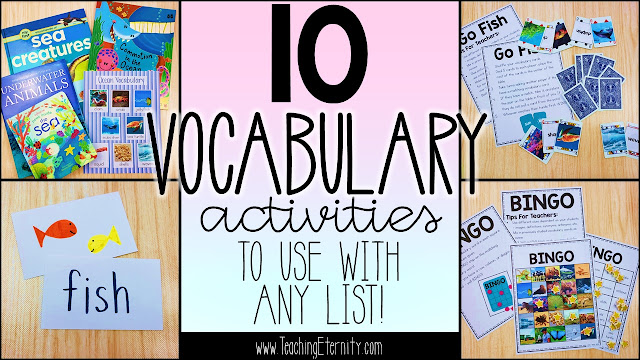
If you teach English Language Learners you know how important vocabulary development is. It can be hard however, to come up with new ways to practice vocabulary. You want to keep your students interested in practicing their vocabulary, and the same old activities just aren't cutting it. So here are 10 different activities you can do with any vocabulary list! 


BINGO

The first one is simple, and maybe one of the activities you already use. BINGO is a great game for all sorts of skills, and when it comes to vocabulary there are all sorts of ways to differentiate the game to fit your learners.  Even starting with just varying the size of your BINGO board can help fit the game to your students. If you put images on your BINGO boards you can use words, definitions, synonyms, or antonyms for the clues. On a BINGO board of ocean words as shown below, rather than calling out simply 'octopus' you can give a clue such as 'this animal has eight arms'. BINGO is a game that all kids love to play!

Memory

Memory is one of my favorite ways to practice vocabulary. And, just like BINGO, it can be differentiated to fit your students. In the game of memory children flip over 2 cards, and see if they can find a match. You can make matches of picture and word, or word and definition, or word and synonym... or any combination that gets kids engaged and thinking. I like to glue my memory pieces to pieces of scrapbook paper so they aren't see-through, then I will laminate and cut them out.

Memory Game from my Ocean Vocabulary Units

Go Fish!

Everyone knows the classic game of Go Fish!, and it can be used to practice vocabulary as well. You can use index cards, or even playing cards to create a deck of vocabulary cards. You can even use the cards from your memory games! Depending on your students you can make the cards with matching pictures, or a picture and word, or a picture and definition. Then hand out the cards and start playing! You'll need to make sure you have enough vocabulary words in your deck to give each student 5 cards, and still have a pond of cards left over. To keep everyone engaged with the game, smaller groups are better - think 2 to 4 players. 


Charades

Charades is a great game to review a lot of vocabulary, maybe at the end of the quarter or semester. Simply place the vocabulary words in a container, then ask students to pull out a word and act it out without speaking. If you've used Total Physical Response to teach any of these vocabulary words, don't be surprised if those motions come up again. You can make this game into a competition by splitting your group into teams and adding a timer. If a team can't guess in the allotted time, the other team can steal the point!

Pictionary

Pictionary works just like charades, but instead of acting it out, students draw it out. Again, Pictionary works better with a large group of review vocabulary, as opposed to a small list. Add all the words into a container, then ask a student to pull one out, draw it, and the rest of the group guesses what they are drawing. To save on paper, have students draw on an erasable surface, like a white board or smartboard. This can be played in teams as well. 

Password

Another game you can play with vocabulary is based on the old gameshow Password - where one student knows the word and tries to get another student to say the word by giving one word clues. This is a great way to practice synonyms. For the word 'waves' a student may give the clues 'water', 'crashing', or 'surf'. This can also be played in teams. The first team to guess the word based on the clues gets the point.

Flashcards

This is a simple way to practice vocabulary. Have students create vocabulary flashcards that they can use to practice their words. You can decide how the cards should be set up. Maybe students will put a word on one side, and a picture on the other. Maybe a word and definition. Maybe a cloze sentence on one side and word on the other. For example: "The _________ dove deep under water with the oxygen tank," "Scuba Diver". Then the flashcards can be used individually or in groups to review the words. At the end of the unit you can put them in a box or folder of vocabulary words to refer back to.

Wordsearch

Do your students love doing wordsearches? Mine always did, and word searches are a great way to practice spelling vocabulary words. You can use an online wordsearch generator to help you create one. This one from Education.com lets you title your wordsearch, and gives you an answer key. They also have some fun thematic borders you can put on your words if that suits you! Then give students a highlighter and let them work on finding the words!
Word Search from my Ocean Vocabulary Units

Crossword Puzzle

Crossword puzzles are another great independent activity for practicing vocabulary. And it can be differentiated for your students. You can use an online crossword puzzle creator like this one, again from Education.com to find a set up for your puzzle. You can choose to give the definition, synonyms, or antonyms as your clue. If you want to use picture clues, you can simply put the vocabulary word into the generator twice (octopus, octopus) then cut off the word clues and add in picture clues before giving it to your students.
Crossword Puzzle from my Ocean Vocabulary Units

Vocabulary Hunt

This game is a chance for students to find their vocabulary words in books, newspapers, or other media. If you are teaching a thematic unit find picture books related to that topic, and then ask students to look through the books for their vocabulary words. Ask them to keep a tally of how many times they find each word. This can be a great way to expose students to higher level texts, without the pressure of being able to read every word. You can do this during a read-aloud too! During one of your readings of a text ask students to put their fingers on their noses, or hands on their heads, etc, whenever they hear a vocabulary word. This will help keep them engaged with the read-aloud, and let you know if they are paying attention.

Want some help getting these activities going in your classroom? Enter your e-mail below and I will send you an editable PowerPoint you can use to create many of these activities for your own classes.


Are there any vocabulary activities your students love that I missed? Did you try one of these activites?Share them with my by commenting or connecting with me by email, michelle@teachingeternity.com, or find me on instagram, @TeachingEternity.


10 Vocabulary Activities for Any List

Saturday, January 15, 2022

One of the first things I did with my students each year was create a personal dictionary.  This was a place where they could record all of the vocabulary we studied throughout the year. It was easily our favorite and most used classroom resource. If you've been thinking about starting personal dictionaries in your classroom let's chat a little bit about what they are, and why they are so great! If you know you want to use one, but aren't sure where to start, we'll cover that too.


First off - you might be asking - What is a personal dictionary? A personal dictionary is a collection of words created by the person that will be using it. For students these may be words that they need to remember how to spell, or vocabulary words they have studied in class. 

Ok, but why should students keep personal dictionaries? Well, many reasons!


You the old joke about not needing to write something down, you'll just remember it? That's a joke for a reason. The fact is that writing something down helps you remember it. And writing down words that they have learned helps students remember them. Taking the time to record new vocabulary into a personal dictionary assists with memory and recall.

A personal dictionary gives students a reference when they can't remember how to spell a word, or remember what it means. In a perfect world your classroom would have a beautiful, large word wall, where you can put all of your vocabulary and their definitions. But for most of us, that is just not practical. If students have those words handy in a notebook right there in their desk they are more likely to use it when they need it.

One of my favorite aspects of the personal dictionary was that it was a physical representation of all of the learning we had done. Since we added new vocabulary regularly, by the end of the year my students had a book overflowing with tangible evidence of all they had accomplished.

So, if I've convinced you to give personal dictionaries a try in your classroom, you might now be wondering how?


In my classroom we used the Picture Dictionary and Dictionary Resource found in my TpT store. For my primary students I knew the list of vocabulary words we would be studying throughout the year, and entered those words into their dictionaries ahead of time. Then, whenever we finished a vocabulary unit they would glue the images into the dictionaries with the matching vocabulary word. For my older students, they kept a binder with alphabet dividers. As they added words they would place the word study graphic organizers behind the correct letter. You can read more about these resources here. (This is an older blog post, and the graphics and fonts in the dictionaries have been updated)


But, you can also create personal dictionaries in a regular old notebook! I prefer composition notebooks over spiral notebooks since they will be used throughout the year, and seem to hold up better going in and out of desks and cubbies. Once you have a notebook, divide the number of pages by 26 (the number of letters in the alphabet. Then, you'll probably want to subtract pages from less common first letters, like Q, X, Z, and add them to more common fist letters, like M, S, and T. Finally, you label the pages for each letter. You can keep it simple and simply write the letter in the top right corner, or you can use the personal dictionary headers freebie I have! Just enter your name and email below to receive the freebie.


If you give personal dictionaries a try in your classroom I would love to hear about it! You can connect with my by e-mail at michelle@teachingeternity.com or find me on Instagram @TeachingEternity

Personal Dictionaries in the Classroom

Thursday, September 30, 2021

As an ESL teacher, vocabulary was frequently the driving force behind my instruction. Whether it was previewing vocabulary before introducing a new science unit, defining unknown words from a guided reading text, or thematic vocabulary lessons, vocabulary has always been a part of my teaching. Teaching vocabulary is not easy. Today I want to share some strategies with you to help your English Language Learners master their vocabulary lessons.


Before we get to the strategies there is something important to keep in mind: do not try to teach too much vocabulary at once. When it comes to curating a list of vocabulary words - LESS is more. Try to choose the most important words from a unit. If, for example, you are working on a science unit on weather. You might focus on the words 'hot', and 'cold' when talking about temperature. You would not want to use all the words to describe the temperature, such as 'warm', 'cool', 'freezing', or 'frigid'. Those subsequent words will most likely come up in your conversations. By focusing on a smaller group of words you can allow students deeper understanding. Before any new unit, preview your vocabulary list and cull out the most significant words for your English Language Learners.

Use Images

Once you have your vocabulary list, there are a few ways to help those vocabulary words stick. One way is to be sure to use images whenever you are introducing new vocabulary. A great place to find images is on Pixabay. Since Pixabay is a collection of images with a creative commons license you will not have to worry about watermarks over the image. You can also use clipart or drawings to depict your vocabulary. However images are easier for children to connect with.


Use Realia

Another trick is to use "realia", or props, to assist with your vocabulary instruction. When I was working with my primary ELLs on the difference between coat and jacket - I brought in my coat, and a lighter weight jacket. I had students try on my coat and jacket so that they could experience the difference. If you are working through a topic that does not allow you to bring in actual items you could bring in toys to represent the vocabulary. For example, during a unit on nutrition you can bring in play food (to avoid allergies). If you are working on the parts of a house you could bring in a doll house.


Total Physical Response

My favorite way to engage students with their vocabulary is through Total Physical Response. TPR is basically 'acting out' or associating hand motions with your vocabulary. One that I used frequently with my elementary level students was when learning the past, present, and future tenses. I would always have students point behind them while saying "past", point at their feet and say "present", then point out in front of them and say "future". For younger learners a favorite was always teaching the difference between gloves and mittens. Students would hold their four fingers together with their thumb sticking out for mitten, then all five fingers spread out for glove. TPR is also very useful when teaching verbs. Students can act out raking leaves or shoveling snow.


Vocabulary in Context

Probably the most important thing to do when teaching new vocabulary is to use the words in context. For English Language Learners it is especially important to practice vocabulary words in all four language modalities - Listening, Speaking, Reading, and Writing. For listening this may look like a follow the instructions activity or a game of telephone. To practice speaking you can use a poem, or have students describe a picture related to the vocabulary. When you are choosing read-alouds or guided reading books, try to find books with your target vocabulary so students can experience the words in new ways. Take vocabulary writing beyond simple definitions by asking students to craft writing pieces like narratives or poems using their words. The Vocabulary Units in my Teachers Pay Teachers Store were all designed with this goal in mind.

Don't 'Use it and Lose it'

Last, but not least, make sure students have the chance to continuing using the vocabulary after the unit is over. Vocabulary is not something you want students to learn for the test, then promptly forget. This may mean putting up a word wall in your classroom. Or providing students with personal dictionaries to keep track of their new vocabulary.


I hope these vocabulary strategies help you and your English Language Learners. Be sure to give one or more of them a try during your next vocabulary lesson. If you do try one out I'd love to hear about it! You can e-mail me at TeachingEternity@gmail.com or find me on Instagram @TeachingEternity. Want to save this post? Click the image below to save it to your Pinterest.


5 Strategies for Making Vocabulary Stick

Thursday, January 14, 2021

When I decided to update my Vocabulary Units, I knew I wanted to include some interactive read-alouds. It is so important to read high quality, engaging texts to all students - English Language Learners are no exception. I was looking for books that would interest students, provide opportunities for discussions, and included rich vocabulary. I also wanted books that weren't too long so that primary level students would attend throughout the story. While I read and loved many winter themed books - these five were my final choices.


Snow by Manya Stojic

A quick and easy read, Snow by Manya Stojic is perfect for the primary classroom and English Language Learners in particular. The book begins with the wise owl making note of winter coming.  Different animals confirm that they also can sense the Snow on the way.  In the beginning of the book the illustrations include orange leaves flying around, hinting at the end of Autumn. In the middle of the book there is a brief look at how different animals survive winter, from bear who sleeps (Hibernation), the rabbits whose fur changes to white (Adaptation), and the geese who fly south (Migration). At the end of the book the owl and illustrations once again predict the season’s change, showing bits of green under the snow and mentioning spring. 

Discussion Questions:

p. 5-6 Moose says, “I can smell it [snow] on the breeze.” What is a breeze? What else is blowing in the breeze? What season is ending?
p. 11-12 Fox says, “Those clouds are full of snow.” Where does snow come from? What else comes from the clouds? How are snow and rain related?
p. 19-20 The bunnies say, “We are as white as we can be, white as snow.” *looking back to pages 9-10* How did the bunnies change? Why did the bunnies fur turn white? This is called adaptation – changes to help an animal survive.
p. 21-22 Bear says, “Snow…snow…so…sleepy.” What does Bear do in winter? Why does Bear ‘sleep’ through the winter? This is called hibernation – when an animal becomes inactive, or sleeps, through the winter.
p. 25-26 The geese say, “South! We’ll fly south!” Why will the geese fly south? When will the geese come back? This is called migration – moving from one place to another
p. 27-28  What does Owl see that tells her spring is coming back? What happens to snow in the spring?

Post-Reading Activity:

After Reading Snow by Manya Stojic, create an anchor chart for the different ways animals survive the winter. Extend the activity by researching other animals that adapt, migrate, and hibernate.

Sugar White Snow and Evergreens: A Winter Wonderland of Color  by Felicia Sanzari Chernesky, illustrated by Susan Swan

When you picture winter chances are good that you’re picturing a blanket of white. However this beautifully illustrated picture book points out all the other wonderful colors of winter. Sugar White Snow and Evergreens: A Winter Wonderland of Color by Felicia Sanzari Chernesky is a fun rhyming text that points out all the beautiful colors in the winter. The illustrations by Susan Swan are a lovely compliment to the text.   From the obvious red cardinal and orange snowman’s nose to the more subtle purple shadows this book takes you through a verifiable rainbow of winter colors.


Discussion Questions:

Before Reading I want you to paint a picture of winter in your mind. What color did you use the most of? Why is white a very important color for the winter?
p. 3-4 The family is getting dressed to go outside. What do you wear to stay warm in the snow? What color is your coat, hat, mittens etc. ?
p. 5-6 They are going to ‘hunt’ for maple syrup. Have you ever had maple syrup? Do you know where it comes from? The text says they are going to a farm – What do you think they will see at the farm?
p. 17-18 The sap from the trees is boiled, or heated, until all the water evaporates and all that is left is the syrup. Why are their stomachs growling? Have you ever been so hungry your stomach growled?
p. 23-24 Notice the trees on the previous page are bare… What happened to their leaves? How are those trees different from these trees on this page? Evergreen trees do not lose their needles in the winter.
p. 27-28 What do you see on these pages and what colors are they?

Post-Reading Activity

Ask students to write about their winter weather gear (coat, boots, etc.). As they write they should include color words to describe the winter clothes. For beginner level students provide sentence stems, such as "My coat is _____." or "I wear a _____ coat.".

Winter is the Warmest Season by Lauren Stringer

Another text that contradicts the way we usually think about winter, Winter is the Warmest Season, by Lauren Stringer, is a fun book about how warm winter actually is.  The author compares summer things like fans that blow cold air to the radiators that bring heat in the winter-time.  The author also talks about how animals and people like to get closer together to stay warm.  The illustrations are bold and colorful.  They go along perfectly with the text and will lend to students’ understanding of the text.


Discussion Questions:

Before Reading I want you to think about winter. What does winter feel like? Most people think of winter as being COLD! However, this book talks about all the ways that winter is warm.
p. 2-3 The boy is getting dressed to go outside. What do you wear to stay warm in the snow? The book says, “My hands wear warm wooly sweaters.” What is on the boy’s hands?
p. 4-5 What animals do you see sleeping under a thick blanket of snow? These animals are hibernating - when an animal becomes inactive, or sleeps, through the winter.
p.8-9 Radiators are a type of heater in older homes.  They often make hissing and clanking sounds when they are on. How do you keep your house warm?
p. 16-17 The boy is comparing summer swims with winter baths. Why does going for a cold swim feel good in the summer? Why does a warm bath feel good in the winter? Which one do you like better? Why?
After Reading Which do you think the boy likes better? Summer or Winter? Why?

Post Reading Activity:

Brainstorm ways to stay warm in the winter. You can do this as a class, or individually. If it's more appropriate for your students, allow them to draw a picture of how they stay warm in the winter.

Best in Snow by April Pulley Sayre

I love Best in Snow by April Pulley Sayre for its us of real photographs.  The close-up photos of snow and ice are especially fascinating.  Each photograph has just a few words to accompany it, making the photographs the driving force in this book.  At the end of the text the author includes some notes about the scientific processes snow goes through as it changes over time.  A great way to show students that snow comes in all different forms – fluffy and fun, to icy and hard.


Discussion Questions:

p. 2-3 Where does snow come from? What else comes from the clouds? How are snow and rain related?
p. 12-13 These three pictures show different snowstorms. How is the snow in these pictures different from one another.
p. 14-15 What do you think causes the sparkle in the snow?
p. 20-21 What happens to snow as the air gets warmer? Where do you usually see icicles?
p. 24-25 When the melting snow mixes with mud it makes slush. Where do you usually see slushy snow?
After Reading What animals did you see in this book? How do you think they feel about the snow?

Post-Reading Activity:

Ask each student to choose their favorite photograph from the book. Then they can describe everything they see in the image. This is great for descriptive writing and noticing details.

No Two Alike by Keith Baker

No Two Alike by Keith Baker is a fast and fun rhyming text that points out differences you can see in winter.  The book starts out with the fact that no two snowflakes are alike.  The illustrations even have easily discernable flakes, so that you can see the differences.  The two cardinals show off other winter differences such as animal homes, and different winter trees.  In the end even their differences are pointed out.  The text is a great reminder of how each one of us is unique – just like snowflakes.


Discussion Questions:

p. 2-3 Did you know that each snowflake is different? Look closely at the snowflakes in the birds’ flight path – notice how they are different.
p. 6-7 On this page we see two nests. Who are these nests homes for? How are the nests the same? And how are the different?
p. 12-13 This picture of the forest shows two different types of trees. Why are some trees bare? The evergreen trees do not lose their needles in the winter.
p. 16-17 How are these two roads different? Where do you think they might lead?
p. 24-25 What animals do you see in the forest? What are they doing?
p. 30-31 Even the two cardinals are just a little bit different, but they are still good friends. Are you friends with someone who is different from you?

Post- Reading Activity:

After Reading, pair students to create a Venn Diagram of the ways in which they are the same and the ways they are different. This is such a great lesson on how we can be friends with someone who isn't exactly like us!


If you are looking for these discussion questions and activities ready-to-print and use please check them out in either my Winter Vocabulary Unit or my Winter Read-Alouds resource in my Teachers Pay Teachers store. If you chose to read any of these books with your students I'd love to hear about it! You can e-mail me at TeachingEternity@gmail.com, or connect with me on Instagram, @TeachingEternity.

Click the Image for a Winter Picture Book List


5 Winter Read-Alouds

Sunday, December 6, 2020

Instagram