SOCIAL MEDIA

Showing posts with label Writing. Show all posts
When I decided to update my Vocabulary Units, I knew I wanted to include some interactive read-alouds. It is so important to read high quality, engaging texts to all students - English Language Learners are no exception. I was looking for books that would interest students, provide opportunities for discussions, and included rich vocabulary. I also wanted books that weren't too long so that primary level students would attend throughout the story. While I read and loved many fall themed books - these five were my final choices.
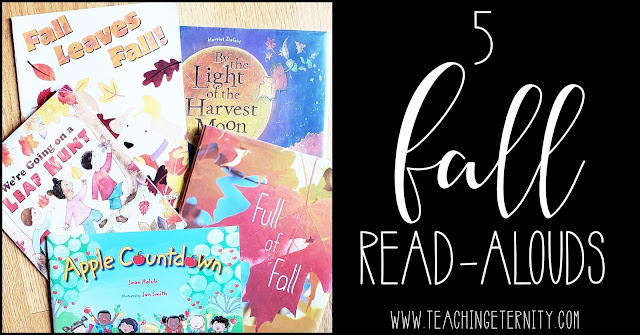

Full of Fall by April Pulley Sayre

April Pulley Sayre’s Full of Fall is a beautiful collection of photographs to portray the fall season. The simple text has a subtle rhythm and rhyme. Students will enjoy both listening to this text as a read-aloud and studying the images in detail. The photographs follow the timeline of fall from the end of summer in September to the first snowfall at the end of the book. The author includes notes at the end of the book to explain the scientific processes that leaves go through.

Discussion Questions

p. 2-3 The first day of fall is September 22nd. The text says, “Green goodbye.”  Why do you think the text says this? What colors do you think of for fall?
p. 12-13 This photo looks like it was taken while laying under the tree. Imagine laying under this tree. What would you hear? What else would you see? How would it feel?
p. 19 Why do you think these leaves are floating in the air?
p. 22-23 The leaves on the ground are dying up. How could those leaves get cleaned up? Tell us about a time you may have helped cleaned up leaves.
p. 30-31 Compare this photograph of a forest to the photograph of a forest at the beginning of the book. What differences do you notice?
p. 34-35 What season comes after fall? What signs of winter do we see in this photo? What is surprising about this picture? The author explains that this kind of tree loses it’s leaves in the spring rather than the fall.

Post-Reading Activity

After reading, have each student choose one photo as their favorite. Then ask them to describe the photo. This can be done in writing or in conversation.

We’re Going on a Leaf Hunt by Steve Metzger, illustrated by Miki Sakamoto

We’re Going on a Leaf Hunt by Steve Metzger is an adorable book about three children going on a leaf collecting adventure.  Just like in the classic book We’re Going on a Bear Hunt by Michael Rosen, the children come to obstacles they can’t go over or under. The surprise at the end that sends them home is good for a giggle. Miki Sakamoto’s illustrations are simple and perfectly compliment the text.

Discussion Questions

before reading The title of this book is We’re Going on a Leaf Hunt. Have you ever read a book with a similar title? What happened in that book. What do you think these 3 friends will see and do on their leaf hunt?
p. 2-3 The friends just climbed a mountain. The author included some sound words – did you hear them? Why do you think those are the sounds for climbing a mountain.
p. 8-9 How are the friends feeling about going through the forest? How can you tell? Have you ever walked through a dark forest? What could be scary in a dark forest?
p. 16-17 These leaves are in a big pile for jumping in. Have you ever jumped into a pile of leaves? Was it fun? Why or why not? How do you think the leaves got into a pile for jumping?
p. 20-21 The friends are putting on life jackets. Why are life jackets important when you are getting in a boat?
p. 25 The friends found a skunk behind the bush. Why are they running away from the skunk?

Post-Reading Activity

After reading, provide students with images to represent each step of the hunt - mountain, forest, waterfall, and lake. Ask students to sequence the images. Add on a writing piece by asking students to write a sentence or label each step.

Apple Countdown by Joan Holub, illustrated by Jan Smith

I remember trips to the apple farm being a favorite growing up, and this book definitely captures all of the fun! Apple Countdown by Joan Holub follows a class of 19 students and 1 teacher on a field trip counting down from 20, all the way to 1.  Along the way there is some helpful information, like the best way to pick an apple, a little bit of science – showing apple trees in all 4 seasons, and even some math! Students in your class will have just as much fun listening to the book and looking at the pictures as the characters do on their field trip.

Discussion Questions

before reading Look at the cover of the book. What do you see? What do you think this story will be about?
19 The class is on the bus headed to a field trip. Have you ever been on a field trip? Where did you go and what did you do there? Where do you think these kids are going?
17 What are some things they think they may see on their field trip. Do these help you guess where they are going?
12 & 11 Applebee farm has apples and bees! Why would bees be an important part of an apple farm? These pages also show different types of apples. What is your favorite kind of apple?
They made apple pies from some apples. What are your favorite ways to eat apples?
1 Throughout the book there have been clues that Lee was going to lose his tooth. Why do you think his tooth finally fell out?

Post-Reading Activity

After reading, ask students to draw or write about an apple tree in different seasons.

Fall Leaves Fall! by Zoe Hall, illustrated by Shari Halpern

Two brothers anxiously await their favorite season – FALL! Fall Leaves Fall is a simple story about many things you can do in the fall.  The brothers catch leaves and collect leaves, they rake leaves and jump into the pile. The illustrations are bright and simple in the most perfect way.

Discussion Questions

p. 1 The text says, “How do we know when fall is coming?” What are some ways we know the season is changing from summer to fall?
p. 6-7 Compare the illustrations on pages 2 and 3 to the illustrations on these pages. What has changed? What has stayed the same?
p. 19 Look at the squirrels. What are they doing? Why are they doing that?
p. 22-23 Have you ever helped rake leaves? Is it a hard job? How else can you get leaves off of the ground?
p. 30-31 The brothers are very excited about their leaf pile What do you think they will do next? Have you ever done that before?
p. 34-35 What season is coming next? What clues do you see in the illustrations?

Post-Reading Activity

After reading, brainstorm different activities for fall as well as activities you would not do in fall.

By the Light of the Harvest Moon by Harriet Ziefert, illustrated by Mark Jones

By the Light of the Harvest Moon by Harriet Ziefert is a fun book about ‘leaf people’ who have a party to celebrate the first day of autumn. The story begins with farmers finishing up the day and heading to bed. The bright moon shines down as the wind blows and the leaf people emerge. They bob for apples and have a pumpkin stacking contest before enjoying fall desserts like pumpkin pie. The illustrations by Mark Jones are beautifully detailed and reflect the glorious colors of the season. 

Discussion Questions

p. 5-6 The text says the farmer is ‘weary’.  What do you think ‘weary’ means?
p. 6-7 The leaf people are decorating a table. What does this remind you of? Has your family ever decorated a table for a big party? Who is this party for?
p. 19 The leaf children are doing lots of fall activities like bopping for apples and pumpkin stacking. What are your favorite fall activities?
p. 22-23 Surprise! They are having a dessert party! What dessert do you see on the table? Which would you like to try?
p. 30-31 What does it mean when it is the fall equinox? The first day of fall is September 22nd. 
p. 34-35 Compare the trees in this photo to the trees in the beginning of the book.  What has happened? What clue did the leaf people leave behind?

Post-Reading Activity

After reading, students can create a poem about fall. A five senses poem or an acrostic poem using the word harvest would be great!

If you are looking for these discussion questions and activities ready-to-print and use please check them out in either my Fall Vocabulary Unit or my Fall Read-Alouds resource in my Teachers Pay Teachers store. If you chose to read any of these books with your students I'd love to hear about it! You can e-mail me at TeachingEternity@gmail.com, or connect with me on Instagram, @TeachingEternity.


Find a free download of fall themed books by signing up below!


5 Fall Read-Alouds

Friday, September 10, 2021

When I decided to update my Vocabulary Units, I knew I wanted to include some interactive read-alouds. It is so important to read high quality, engaging texts to all students - English Language Learners are no exception. I was looking for books that would interest students, provide opportunities for discussions, and included rich vocabulary. I also wanted books that weren't too long so that primary level students would attend throughout the story. While I read and loved many teacher themed books - these five were my final choices.


Same Way Ben by Maryann Cocca-Leffler

Same Way Ben by Maryann Cocca-Leffler is a great book for students about to experience their first substitute teacher. Ben did the same thing every day, he put on the same clothes, went to school, sat at the same table, ate the same lunch, and everything was perfect! However, Ben’s world gets thrown for a loop when suddenly there is a substitute teacher, and nothing is the same at all. With the help of friends and a special teacher, Ben learns to embrace the change. 

Discussion Questions

p. 5 Ben likes things the same every day. Is there anything that you like to keep the same every day? Are there things that you like to change?
p. 8-9 How is Ben feeling? Why do you think he is feeling this way? Have you ever felt sad or nervous about something changing?
p. 16-17 Even more things are changing in Ben’s class. What do you think Ben should do about all the changes? Is there someone he could talk to?
p. 22 Mrs. Garcia says, “Changes make life exciting… like an adventure!” Do you agree with Mrs. Garcia? Why or Why not?
p. 26-27 Ben is trying something new! Looking closely at the picture - What is Ben doing that is different that his usual routine?
after reading What did Ben learn about change? Have you ever had to make a change you were scared about, but it was a good change in the end?

Post-Reading Activity

After reading, complete a story map to identify the setting, characters, beginning, middle, and end. This book would also be a great way to start the conversation around the expectations when there is a substitute teacher.

First Day Jitters by Julie Danneberg, illustrated by Judy Love

This book is a classic beginning of school story – and for good reason. It gives students a glimpse into a teacher’s thoughts and feelings on the first day of school. Up until the very end readers believe that Sarah Jane Hartwell is a student nervous about her first day of school. Every kid can empathize with her reluctance to start at a new school. Reading this book and sharing your feelings about the first day with your own students will help to create a caring and empathetic classroom.

Discussion Questions

before reading This book is called First Day Jitters. Do you know what the ‘jitters’ are? It means you feel nervous. Do you feel nervous on the first day of school?
p. 4 Sarah says, “I hate my new school.” Why do you think she says that? Has she ever been to the school? Have you ever said you didn’t like something before you tried it?
p. 6-7 Look at these two groups of students. Which group would you like to go to school with? Why?
p. 15 Sarah says, “My head hurts.” Why does she say that? Have you ever gotten a headache or stomachache thinking about doing something you didn’t want to do? Do you think she should stay home today?
p. 24-25 Look at the classroom – how is it like your classroom? How is it different?
after reading Sarah is the teacher! Did you know that teachers can feel nervous on their first day of school too?

Post-Reading Activity

After reading, compare the ways you, as a teacher, feel on the first day of school with the ways students feel on the first day of school. Be honest with your students about your feelings. This can help with building relationships in the classroom.

School’s First Day of School by Adam Rex, illustrated by Christian Robinson

This lovely book is told from the point of view of a new school building. When Janitor tells School that soon teachers and children will be coming School becomes nervous. When the first day finally arrives, School is disheartened to learn that not everyone likes him. However, as the day goes on things get better for everyone. After all the students go home, Janitor returns, and School tells him all about the day. School decides that being a school is lucky after all!

Discussion Questions

p. 1 Look at the school they have built! Can you see School’s face? Watch for that face carefully because it will change in the story to tell us how he is feeling. Does this school look like your school? How is it the same? How is it different?
p. 6-7 Look at this big room – what do you see? What different things can this room be used for?
p. 8-9 Look at School’s face now. How is he feeling? Why do you think he is feeling that way? How did the children get to school?
p. 17 Why do you think the little girl says that she does not like school? How is she feeling? Have you ever felt that way about school?
p. 26 Look at school now, at the end of the day? How is he feeling? Why do you think he is feeling better? What happened that made him happy?
after reading What makes a school special, and different from a house? Do you think school will be nervous to have the children back tomorrow?

Post-Reading Activity

After reading, create a character map for School. Use what he says and thinks to fill in the map.

How to Get Your Teacher Ready by Jean Reagan, illustrated by Lee Wildish

This adorable book takes students through various important dates in the school year. For each special day there are jobs students can do to help their teacher get ready. There are even plans for when the day doesn’t go as planned. How to Get Your Teacher Ready by Jean Reagan is a perfect read-aloud for the beginning of the school year. 

Discussion Questions

p. 2-3 This page is “How to Welcome your Teacher” What are some ways you can make your teacher, or another classmate feel welcome in our class?
p. 8-9 Have you ever performed in a concert? How is the teacher feeling? How do you know? What helps them to feel better?
p. 12-13 This day did not go as planned! What went wrong? What did they do to fix it? What other ways can you try to fix a bad day at school?
p. 14-15 These students are teaching their teacher about their favorite topics? What is your favorite thing to learn about? Who do you like to talk about that topic with?
p. 16-17 They are getting ready for field day? What do you know about field day? What kind of games do you play on field day?
after reading This book talked a lot about special events at school. What special events at school are your favorites? How do you and your teachers get ready for them?

Post-Reading Activity

After reading, brainstorm ways that students can help their teachers.

Clothesline Clues to the First Day of School By Kathryn Heling and Deborah Hembrook, illustrated by Robert Davies

If you’ve read any of the Clothesline Clues books – then you’ll know this is a good one. Every other page gives clues to someone who works at school, followed by a page of them doing their job. Students will love guessing who is who based on the clues. 

Discussion Questions

Allow students to guess the school staff member after each page.

Post-Reading Activity

After reading, students can create clues to school personnel. They can then present the clues to the group.  


If you are looking for these discussion questions and activities ready-to-print and use please check them out in either my People at School Vocabulary Unit or my People at School Read-Alouds resource in my Teachers Pay Teachers store. If you chose to read any of these books with your students I'd love to hear about it! You can e-mail me at TeachingEternity@gmail.com, or connect with me on Instagram, @TeachingEternity.


Click the image above for a list of more picture books about people at school.


People at School Read-Alouds

Wednesday, August 18, 2021


A few weeks ago, my third grade cooperating teacher and I started our Opinion Writing unit.  We defined opinion, modeled opinion writing, provided students with a graphic organizer.


Common Mistakes

They all got to work writing about a Noteworthy Person.  As we started conferencing however we noticed a troubling trend in their writing pieces... our students were struggling with either:
 A.) The difference between a REASON and an EXAMPLE (to support the reason)
or
B.) Making sure their EXAMPLES matched their reasons!
or
C.) Writing really vague and unspecific reasons

We knew we had to do something, and I knew I had the perfect opinion piece to help them really Get It!


Classroom Activity

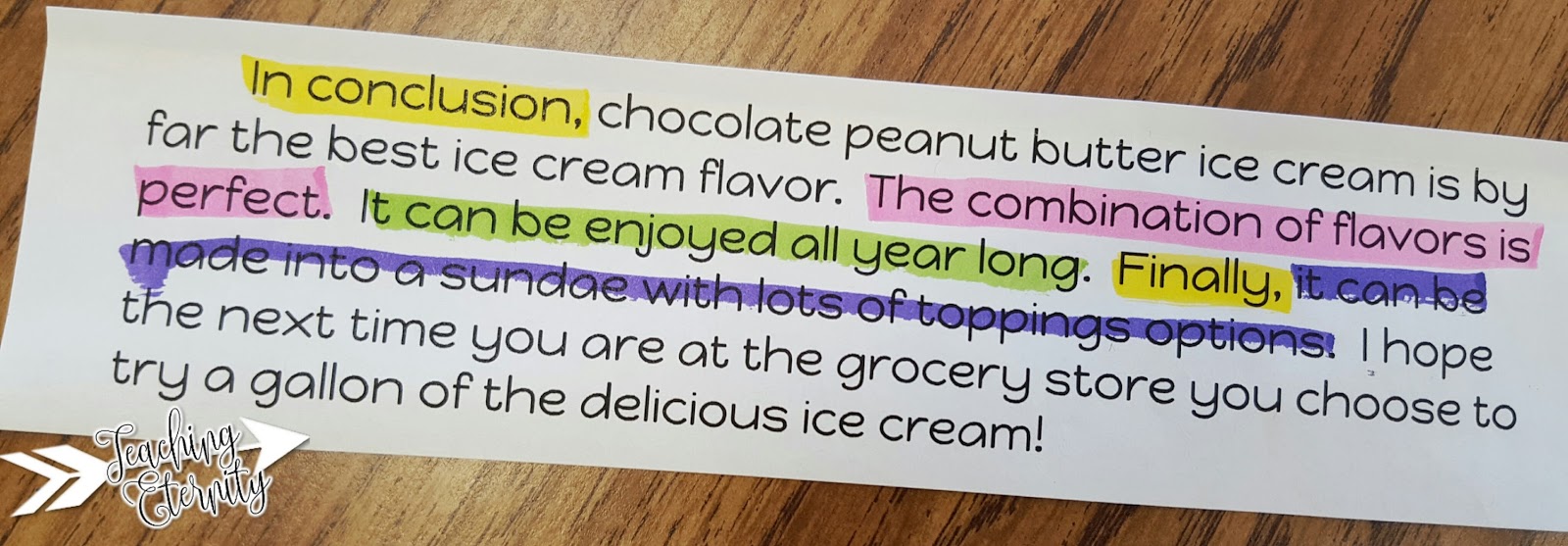
Step one: Find an opinion essay that is relate able and well-organized (if you don't have one, you can find mine at the bottom of this page). I had written this essay as a model for my 5th grade students a few years prior.  My 3rd graders felt like rock-stars when I told them they were going to be using a 5th grade essay!  I spaced out my essay leaving my Introduction and Conclusion paragraphs in tact, then putting my reasons, and 3 examples each on separate lines so they could be cut apart.

Step 2: Provide students with their Opinion Essay Organization Kits.  Mine consisted of 4 markers, one long sheet of construction paper (I cut a large sheet in half), and my cut apart essay.


Step 3: Students should locate the full paragraphs and determine which is the Introduction and which is the Conclusion.  This was a no-brainer for them since my conclusion literally begins "In conclusion".  However, we were also trying to get them to use appropriate transitional phrases, so this was another way to drive this idea home.  We used the yellow marker to highlight the transitions. Then they glued the introduction at the top, and the conclusion at the bottom.


Step 4: I asked the groups to read through the introduction to find my three reasons.  Again, they had to look for transitions here.  They highlighted the transitions in yellow, reason one in pink, reason two in green and reason three in purple.


Step 5: Now they had to search through the twelve smaller pieces to find my reasons again, since my reasons were also the first sentence of each of my paragraphs.  They had begun to catch on to the importance of the transition words and started looking for them at the beginning of the sentences.  I tricked some of them by using different transitions than I did in my introduction, but they figured it out quickly enough.  Once again we highlighted the transitions in yellow, and put dots on the slip to match the colors in the introduction (1= pink, 2= green, 3= purple).

Step 6: This was the hard part.  They had nine strips left, three examples for each of my three reasons.  They had to put these examples in the correct paragraph with the correct reason.  Some of these were easier than others.  They worked together though to figure it out.  Once that part was done we congratulated them on meeting our activity objective... but we weren't finished yet!


Step 7: This was the really hard part!  This, I told them was the challenge; this, was where they got to think like 5th graders.  They had to put the examples in an order that made sense!  If the example had the word HOWEVER that meant it had to come after an example stating the opposite (back to the importance of the transitions).  They also had to think about Big Idea to Small Idea.  This was something we did mostly as a whole group, until VOILA! my essay was complete.


Ok, one more step... we highlighted where I restated each reason in my conclusion as well!


Help Your Students Organize their Opinion Writing with this Engaging Activity

Thursday, April 13, 2017

As an ENL teacher I often push-in to writing instruction at multiple grade levels.  One thing I notice students struggling with over and over is where to put quotation marks. Either they put quotations around the entire sentence or only a few words!  I tell students all the time, "Quotation marks are not confetti!"


So how do I combat the quotation confetti?  Every year at every grade level during the narrative writing unit the topic of how to use quotation marks comes up.  In first grade I teach students my trick.  What's my trick? 


It's that simple... I tell them to imagine a speech bubble.  Any words in the speech bubble go inside the quotation marks.  Then we practice with some sentences! 

I show three examples; one with the dialog after the tag, one with the dialog before the tag, and one with the tag in the middle.  I will briefly touch on putting in commas and capitalizing the first word... but don't expect them to remember that one right away. (I usually start emphasizing it in second and third)  

Find these practice sheets for FREE here

Then, they will have a laminated blank speech bubble in their writing binder or folder.  If they are confused in the future they can use their dry erase markers to test out what goes inside the speech bubble and therefore inside the quotation marks.

Birthdays are a popular narrative topic!
Is this a perfect strategy? Certainly not!  Students still need reminders to think of their speech bubble. After the initial lesson in first grade I will ask in second, third (etc), "Do you remember Mrs. H's trick?"  Many students who were in the class the previous year will remember.  By third grade they are explaining my trick to their classmates!

Want to share this with friends?  Pin this image:


Find the Practice Sheets you see in the post here:


 photo Signature_zps73d808b4.png

Quotation Marks are NOT Confetti

Thursday, March 16, 2017

On Sunday, September 18th I posted a FB Live video all about my plans for fall week with my Kindergarten student.  They were lovely plans, full of hope and high expectations.  However, things did not go that way due to this, that, and the other thing.  So I thought I'd pop-in and share what actually happened during our Fall Vocabulary Weeks (because we stretched it through 2 weeks)!


Monday 9/19 - Today went as planned.  I started by introducing the vocabulary words for the week.  My student already knew 2 of the 6 words (apple and pumpkin), which was good to build his confidence, and give him a point of reference.  We practiced saying the words with him repeating them after me three times.  
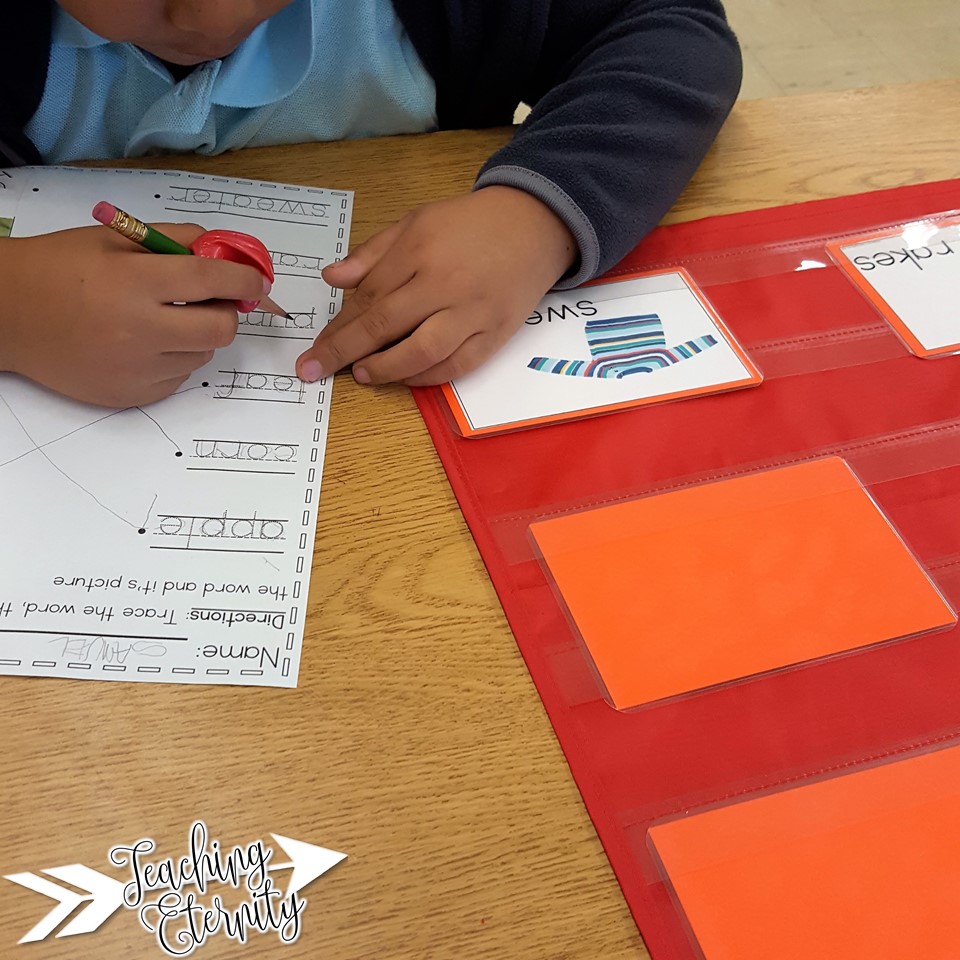
We then moved to the table to work on our listening activity.  I brought the pocket chart with words over to the table so that we could reference the words he didn't know like sweater and rakes.


Tuesday 9/20 - Another day as planned.  We started by reviewing our words (3 times again) and then we moved to the table to trace and match our words.  At first this was more difficult for him than I anticipated, even with the pocket chart right there to reference.  About half-way through though he figured out the expectation and did very well.  

We then moved back to our mat to read the Apple Tree poem.  He thought this was a lot of fun.  Especially when we pretended to pick one of the apples and eat it!  We moved back to the table one more time and he was able to color in his own copy of the poem.  We discussed the colors of an apple tree.


Wednesday 9/21 - We started our time together just as any other day, by reviewing our words three times.  Today was the day he produced the third word independently (rakes).  We read our easy reader by him repeating me.  However he did practice pointing to each word.  Then we did a picture sort of 'Things you see in fall; Things you do not see in fall".  I wish I knew where this activity was from, but I do not.  I downloaded it (I think) from a blog post years ago, and I can not find it again.  


Thursday 9/22 - We started again by reviewing our words.  Then I read the book Fall Leaves Fall by Zoe Hall.  This was an interactive read-aloud, and we stopped to talk about the pictures and text frequently.  Then we went to the table and I introduced the writing task.  I showed him the pictures from the book again of all the things to do with fall leaves.  His favorite was to make a monster, and so he drew a leaf and made it a monster!  It was a super cute picture.  I wrote his sentence.  He started to trace it, but we ran out of time to finish.

Friday 9/23 - Our group was cancelled due to a scheduling conflict with school pictures and library time.

Monday 9/26 - Once again we reviewed the words.  I re-read Fall Leaves Fall and we traced and colored fall leaves using this freebie from KidSparkz.  He really enjoyed matching the leaves in his book to the shapes of the leaves in the read-aloud. He colored his pages to match the leaves in the book.  

Tuesday 9/27 - We reviewed the words to start our time and he was able to recognize apple, pumpkin, rakes and leaf independently.  I wanted to do some speaking practice so we sequenced the steps of making a jack-o-lantern.  I printed off the colored copy and student cut and glue page from this free pack by S is for Sarah.  We did the colored one together then talked through it.  I'd point to one of the pictures and he'd say what he saw, then I would turn that into a full sentence for him to repeat.  For example the 4th picture was drawing a face on the pumpkin.  My student said "face", I gave the sentence "Draw a face on the pumpkin" then he repeated it.  Then I gave him the student activity sheet and he cut out and glued the steps in order.  I explained that the first picture was of a pumpkin, and at the end it was a jack-o-lantern with a face.
  

Wednesday 9/28 - I was unable to be in school. :(

Thursday 9/29 - When we reviewed the words this day he knew all but sweater independently.  I decided to focus the day on apples and do some letter recognition practice, and sight word practice.  We re-read our apple poem.  Then I gave him this tree to color the apples either red, yellow, or green depending on the letter I'd put in them.  

Then we read the sight word sentence at the top, which featured the week's focus words.  Then I used the "I like..." flip book from Lavinia Pop's Fall Sight Word Fluency Flip Books.  He really liked this book.  

Friday 9/30 - The plan for today was to glue our fall words into his picture dictionary, however it hadn't come back from our printer yet.  So we reviewed our words and played memory.  We needed the pocket chart to make sure the words matched with the pictures.  I was really happy with his recall of what each picture was.  I didn't expect him to actually read the words independently at this point, but he learned the routine of the game and strategies to figure out the words by checking in the pocket chart.   I sent home the activity pages we'd finished along with some fall books from Reading A-Z today too!


So, all in all, things did not go completely as planned, but I think they went even better.  We did a lot of listening, speaking, reading and writing practice.  I was very happy with the progress my student made in recognizing and using the vocabulary.  The majority of our activities from the first week of our fall unit can be found in my Fall Vocabulary Unit in my TPT store.  We will spend the next few weeks focusing on school vocabulary: People, Places, Supplies and Things We Do at School.  


 photo Signature_zps73d808b4.png

Fall Vocabulary Unit: The Reality

Monday, October 3, 2016

Instagram